

The Dream Lives On
Dr. Martin Luther King, Jr.
Famous Speeches & Interviews of MLK
If I had Sneezed
I Have A Dream
The Other America
NBC NEWS Interview
I've Been to the Mountain Top
What Is Your Life's Blueprint *
1968 - The Merv Griffin Show Interview *
A riot is the language of the unheard
Why Jesus Called the man a Fool
Life Every Voice and Sing *
1968 King Assassination Report (CBS News)


You may not have known about
Dr. Martin Luther King, Jr.
1. King's Birth Name Was Michael, Not Martin
King was born Michael King Jr. on January 15, 1929. In 1934, however, his father, a pastor at Atlanta’s Ebenezer Baptist Church, traveled to Germany and became inspired by the Protestant Reformation leader Martin Luther. As a result, King Sr. changed his own name as well as that of his five-year-old son.
2. King Entered College At the Age of 15
King was such a gifted student that he skipped grades nine and 12 before enrolling in 1944 at Morehouse College, the alma mater of his father and maternal grandfather. Although he was the son, grandson, and great-grandson of Baptist ministers, King did not intend to follow the family vocation until Morehouse president Benjamin E. Mays, a noted theologian, convinced him otherwise. King was ordained before graduating college with a degree in sociology.
3. King Received His Doctorate in Systematic Theology
After earning a divinity degree from Pennsylvania’s Crozer Theological Seminary, King attended graduate school at Boston University, where he received his Ph.D. degree in 1955. The title of his dissertation was “A Comparison of the Conceptions of God in the Thinking of Paul Tillich and Henry Nelson Wieman.”
4. King’s 'I Have a Dream Speech Was Not His First At the Lincoln Memorial
Six years before his iconic oration at the March on Washington, King was among the civil rights leaders who spoke in the shadow of the Great Emancipator during the Prayer Pilgrimage for Freedom on May 17, 1957. Before a crowd estimated at between 15,000 and 30,000, King delivered his first national address on the topic of voting rights. His speech, in which he urged America to “give us the ballot,” drew strong reviews and positioned him at the forefront of the civil rights leadership.
5. King Was Imprisoned Nearly 30 Times
According to the King Center, the civil rights leader went to jail 29 times. He was arrested for acts of civil disobedience and on trumped-up charges, such as when he was jailed in Montgomery, Alabama, in 1956 for driving 30 miles per hour in a 25-mile-per-hour zone.
6. King Narrowly Escaped an Assassination Attempt a Decade Before His Death
On September 20, 1958, King was in Harlem signing copies of his new book, Stride Toward Freedom, in Blumstein’s department store when he was approached by Izola Ware Curry. The woman asked if he was Martin Luther King Jr. After he said yes, Curry said, “I’ve been looking for you for five years,” and she plunged a seven-inch letter opener into his chest. The tip of the blade came to rest alongside his aorta, and King underwent hours of delicate emergency surgery. Surgeons later told King that just one sneeze could have punctured the aorta and killed him. From his hospital bed where he convalesced for weeks, King issued a statement affirming his nonviolent principles and saying he felt no ill will toward his mentally ill attacker.
Recommended for you
7. King's Last Public Speech Foretold His Death
King had come to Memphis in April 1968 to support the strike of the city’s Black garbage workers, and in a speech on the night before his assassination, he told an audience at Mason Temple Church: “Like anybody, I would like to live a long life. Longevity has its place. But I’m not concerned about that now … I’ve seen the Promised Land. I may not get there with you. But I want you to know tonight, that we, as a people, will get to the Promised Land. And I’m happy tonight. I’m not worried about anything. I’m not fearing any man. Mine eyes have seen the glory of the coming of the Lord.”
8. Members of King’s Family Did Not Believe James Earl Ray Acted Alone
Ray, a career criminal, pled guilty to King’s assassination but later recanted. King’s son Dexter met publicly with Ray in 1997 and argued for the case to be reopened. King’s widow, Coretta, believed the Mafia and local, state, and federal government agencies were deeply involved in the murder. She praised the result of a 1999 civil trial in which a Memphis jury decided the assassination was the result of a conspiracy and that Ray was set up to take the blame. A U.S. Department of Justice investigation released in 2000 reported no evidence of a conspiracy.
9. King's Mother Was Also Slain by a Bullet
On June 30, 1974, as 69-year-old Alberta Williams King played the organ at a Sunday service inside Ebenezer Baptist Church, Marcus Wayne Chenault Jr. rose from the front pew, drew two pistols, and began to fire shots. One of the bullets struck and killed King, who died steps from where her son had preached nonviolence. The deranged gunman said that Christians were his enemy and that although he had received divine instructions to kill King’s father, who was in the congregation, he killed King’s mother instead because she was closer. The shooting also left a church deacon dead. Chenault received a death penalty sentence that was later changed to life imprisonment, in part due to the King family’s opposition to capital punishment.
10. George Washington, Abraham Lincoln, and Cesar Chavez are the Only Other Americans to Have Had Their Birthdays Observed as a National Holiday
In 1983 President Ronald Reagan signed a bill that created a federal holiday to honor King. The holiday, first commemorated in 1986, is celebrated on the third Monday in January, close to the civil rights leader’s January 15 birthday.

Hear the Actual Voices of Former Slaves


Crash Course on Black History
Slave Farming
May be America's Last Slave
They were her property: White Women as Slave Owners in the American South*
The Tuskegee Syphilis
Experiment
Considered 3/5 of a Man
The Red Summer of 1919
Top 5 Overlooked
Black History Facts
Lost, Stolen, or Strayed - 1968
China's Original
Black African Roots

The Statue of Liberty
Original Configuration
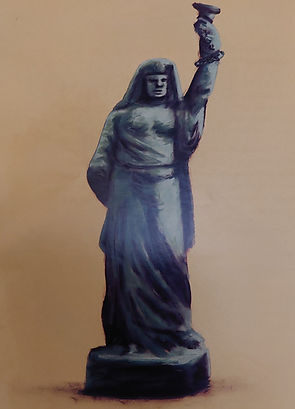
The Statue of Liberty was originally the model of a Black woman holding chains. French historian Edourd de Laboulaye, Chairman of the French anti-slavery society, together with the sculptor Frederic Auguste Bartholdi, proposed to the government of France that the French people present to the people of the United States the gift of the Statue of Liberty.
The statue would be in recognition of the fact that Black soldiers played a role in winning the Civil War in the United States ending African bondage there. In 1884, when the model of the statue was presented to the US Minister to France, he felt that the dominant view of the broken chains would be offensive to the United States South because it would be a reminder to the beaten South that their despised captives had participated in winning their freedom. Bartholdi was encouraged to alter the image and change the model to what we see today in New York Harbor.
